Pitty I missed the Future Summit in Brussels two weeks ago... I would've loved to hear Mike Walsh speaking. Luckily, it becomes a habit for conference organizations to post highlights and interviews from the event on Youtube. Here's the interview with Mike, where he gives some advise for companies on how they should transform themselves to deal with the future.
(From FlandersDC) "Mike Walsh explains how to be a futurist: not by focusing on technology but on anthropology. Look what consumers in emerging markets are doing. Understand the power of networks: not how consumers are connected to you but to each other. Walsh ends with his advice for media companies: collect data on what/who people are. Stop playing the paywall game unless you want to lose to the revolutionaries."
Friday, May 27, 2011

Wednesday, May 25, 2011
Why humans are addicted to predictions that (almost) always prove to be wrong
Haven't read Dan's book yet ('Future Babble: Why Expert Predictions Are Next to Worthless, and You Can Do Better ', it's on my list), but in the meantime it's interesting to hear the author talk about it. The book is about why humans are so desperately in need of predictions, even if most of them never come true. In fact, it's even relatively insane to even listen to 'experts' talking about the future...
But wait a minute... Is this not what I try to do when looking at megatrends? Well, yes and no... to say it in the words of management guru Peter Drucker: “The trends that I have described are not forecasts [...]; they are, if you will, conclusions. Everything discussed here has already happened; it is only the full impacts that are still to come”. In that way I stay far clear of any 'prediction', although, since I'm a human after all, I can't completely omit them...
', it's on my list), but in the meantime it's interesting to hear the author talk about it. The book is about why humans are so desperately in need of predictions, even if most of them never come true. In fact, it's even relatively insane to even listen to 'experts' talking about the future...But wait a minute... Is this not what I try to do when looking at megatrends? Well, yes and no... to say it in the words of management guru Peter Drucker: “The trends that I have described are not forecasts [...]; they are, if you will, conclusions. Everything discussed here has already happened; it is only the full impacts that are still to come”. In that way I stay far clear of any 'prediction', although, since I'm a human after all, I can't completely omit them...
Monday, May 23, 2011
Is our future made of 'peer-to-peer' services?
In a previous note I was wondering which other activities might be subject to 'desintermediation', through the emergence of 'peer-to-peer' platforms. I mentioned banking, music production, even Health Care as being prone to this trend, but I wasn't looking far enough... this short vision published by fastcompany.com reveals plenty more possibilities. I doubt whether this vision would make my life easier, but it would certainly make it more sustainable and less expensive...
From FastCompany
From FastCompany
This could be your life: You wake up and whip up omelets with tomatoes fresh from your SharedEarth.com garden before dressing your toddler in Gap cargo pants you scored on ThredUp. Your Zimride whisks you to the office, where you race to your Freecycle laptop to book your anniversary getaway -- a cozy Parisian flat -- on AirBnB. To zip around to the afternoon meetings you arranged at LiquidSpaces, you unlock your VW RelayRide in the parking lot. When you realize you forgot to buy those new nightstands, you hire a runner on TaskRabbit to swing by Ikea, pick them up, and assemble them with a drill borrowed from NeighborGoods. After this exhausting day, you arrive home to a hot filet mignon dinner for two from Gobble and two copies of Fodor's Paris from BookCrossing resting on your new nightstands. Does that sound good? If so, these sites can make the dream reality.
SHAREDEARTH.COM
A free net linking landowners with gardeners and farmers.
THREDUP.COM
A marketplace for used kids clothes and toys, swapped out by the box; not sentimental, but certainly practical!
ZIMRIDE.COM
Ride sharing for coworkers and students.
FREECYCLE.ORG
If you've got stuff that you're ready to part with for free, this site will direct you to new owners -- not the landfill.
AIRBNB.COM
Arguably the hottest sharing net, this is the place to rent other people's floors, rooms, homes, yachts -- even igloos.
LIQUIDSPACE.COM
A mobile app for finding available work spaces, anywhere from a corporate campus to a spare conference room.
RELAYRIDES.COM
Insured car-sharing with neighbors.
TASKRABBIT.COM
Matches people who need tasks done with runners -- aka "rabbits" -- willing to do them, for a price.
NEIGHBORGOODS.NET
It's the backyard fence, online. Here, neighbors can share home appliances, sports equipment, tools, and more.
GOBBLE.COM
Meals prepared and delivered by neighborhood chefs.
A free net linking landowners with gardeners and farmers.
THREDUP.COM
A marketplace for used kids clothes and toys, swapped out by the box; not sentimental, but certainly practical!
ZIMRIDE.COM
Ride sharing for coworkers and students.
FREECYCLE.ORG
If you've got stuff that you're ready to part with for free, this site will direct you to new owners -- not the landfill.
AIRBNB.COM
Arguably the hottest sharing net, this is the place to rent other people's floors, rooms, homes, yachts -- even igloos.
LIQUIDSPACE.COM
A mobile app for finding available work spaces, anywhere from a corporate campus to a spare conference room.
RELAYRIDES.COM
Insured car-sharing with neighbors.
TASKRABBIT.COM
Matches people who need tasks done with runners -- aka "rabbits" -- willing to do them, for a price.
NEIGHBORGOODS.NET
It's the backyard fence, online. Here, neighbors can share home appliances, sports equipment, tools, and more.
GOBBLE.COM
Meals prepared and delivered by neighborhood chefs.
BOOKCROSSING.COM
Readers trade books with other readers and track them as they travel the globe.
Readers trade books with other readers and track them as they travel the globe.
READ MORE ABOUT THE SHARING ECONOMY AT FASTCOMPANY.COM/THESHARINGECONOMY
A version of this article appears in the May 2011 issue of Fast Company.
Thursday, May 19, 2011
The real benefits of the Internet of Things seen through the eyes of 3 major players
The Internet of Things (IoT) is a trend that promises to shake up our existence quite dramatically. At least, that's what many tech providers want us to believe.
One might get skeptical about the real need for our fridge to tell us whether the milk inside it is running empty. You might as well open the door and check. Our what about our jogging shoes that keep track of our route and post it real time on our Facebook-page? Surely this would make a fascinating read for all my friends?
All jokes aside, the Internet of Things does much more than that. It could make our energy usage more efficient, monitor the physical environment much closer in order to make smarter use of it, and it could make living in (ever growing) cities more sustainable.
To obtain a better understanding of the potential of the IoT, it's worthwhile to examine the positions of its 3 major players: Cisco, IBM and HP.
Let's start with Cisco. In this clip (if you manage to watch it fully without being distracted by the nerving background music) Cisco focuses on the monitoring function of the IoT (for water usage and health, for instance). Interestingly, it starts with saying the IoT could help to bridge the gap between rich and poor, but does not explain why (well, you'd have to deduce it from what follows).
To IBM the IoT is more something inherent to our lives, and benefiting from it is more a question of getting the wisdom out of all the data collected. In this clip IBM stresses the benefits for personal use of the IoT, although this is part of their generic 'Smarter Planet' project so ultimately would benefit society as a whole. No thorough explanation here neither.
HP communicates on the IoT through a series of interviews with people in HP Labs. Unsurprisingly it stresses the fact that HP has the end-to-end solution for the IoT. To be fair, this is only one of the many interviews one can find on Youtube, and the overarching vision of HP is put in its CeNSE program (Central Nervous System for the Earth) which has already a flagship project with Shell.
So, the IoT has some promises and, as stated in the Cisco video, it has some bottlenecks before it can realize its full potential.
However, there's one aspect that none of these video's reflect. No doubt the trillions of datapoints gathered are of enestimable worth (if analyzed efficiently). But where will it be stored? Who will own this data? Will we have to pay for using it? If so, we might end with 3 different wireless tags on each product, each of them for different data collectors... this just doesn't make sense...If not, this would mean that all providers should open their database to anyone else. The latter make sense. As stated in the clips above, the real value is not the data itself, but the wisdom we can get from it!
One might get skeptical about the real need for our fridge to tell us whether the milk inside it is running empty. You might as well open the door and check. Our what about our jogging shoes that keep track of our route and post it real time on our Facebook-page? Surely this would make a fascinating read for all my friends?
All jokes aside, the Internet of Things does much more than that. It could make our energy usage more efficient, monitor the physical environment much closer in order to make smarter use of it, and it could make living in (ever growing) cities more sustainable.
To obtain a better understanding of the potential of the IoT, it's worthwhile to examine the positions of its 3 major players: Cisco, IBM and HP.
Let's start with Cisco. In this clip (if you manage to watch it fully without being distracted by the nerving background music) Cisco focuses on the monitoring function of the IoT (for water usage and health, for instance). Interestingly, it starts with saying the IoT could help to bridge the gap between rich and poor, but does not explain why (well, you'd have to deduce it from what follows).
To IBM the IoT is more something inherent to our lives, and benefiting from it is more a question of getting the wisdom out of all the data collected. In this clip IBM stresses the benefits for personal use of the IoT, although this is part of their generic 'Smarter Planet' project so ultimately would benefit society as a whole. No thorough explanation here neither.
HP communicates on the IoT through a series of interviews with people in HP Labs. Unsurprisingly it stresses the fact that HP has the end-to-end solution for the IoT. To be fair, this is only one of the many interviews one can find on Youtube, and the overarching vision of HP is put in its CeNSE program (Central Nervous System for the Earth) which has already a flagship project with Shell.
So, the IoT has some promises and, as stated in the Cisco video, it has some bottlenecks before it can realize its full potential.
However, there's one aspect that none of these video's reflect. No doubt the trillions of datapoints gathered are of enestimable worth (if analyzed efficiently). But where will it be stored? Who will own this data? Will we have to pay for using it? If so, we might end with 3 different wireless tags on each product, each of them for different data collectors... this just doesn't make sense...If not, this would mean that all providers should open their database to anyone else. The latter make sense. As stated in the clips above, the real value is not the data itself, but the wisdom we can get from it!
Wednesday, May 18, 2011
Making globalization work, some practical ideas
Let’s face it; the current state of globalization doesn’t live up to its promise. While in theory more international trade would mean more wealth to more people, in practice it only benefits a few countries, en within these countries a handful of companies and persons.
Click here to buy on Amazon.com:
Check out my previous book reviews:
The supposed ‘trickle down’ effect (where the wealth of the riches automatically cascade downwards to the poor) is not occurring, and countries that have focused on their ‘competitive advantage’, as economic doctrine pushes them to do, at the end have found themselves dependent on the goodwill of more powerful (and often more protective) counterparts.
Is globalization therefore evil? Not so, according to Nobel prize winner Joseph Stiglitz, is has only not been applied adequately.In his ‘Making Globalization Work ’, Stiglitz provides a thorough account on where the mechanisms of the current globalization fail, and –more importantly- provides some concrete ideas on how these mechanisms could be changed to work for the greater good. Some examples:
’, Stiglitz provides a thorough account on where the mechanisms of the current globalization fail, and –more importantly- provides some concrete ideas on how these mechanisms could be changed to work for the greater good. Some examples: Making trade fair
Trade obviously is at the heart of globalization, and pumping this heart are the agreements and rules made between countries in the ‘World Trade Organization (WTO)’. These rules, however, are largely influenced by the bigger countries to protect their core interests. Trade has never been free, nor fair, argues Stiglitz. From the European cows who are subsidized at twice the level of human subsistence (1$ a day, according to UN definition), to the US using creative definitions of ‘dumping’ in order to levy taxes on some critical goods (critical in the sense that they have a large industry producing these same goods), Stiglitz goes at length about the unbalanced way international trade is being organized today.
The system is particularly unfair to smaller countries, who’s political and economical weight are mostly insufficient to defend their interest, or even to defend themselves when their interests are threatened. One of the ideas Stiglitz proposes, is to enable these smaller countries to sell these litigations to more powerful countries. If the US harms the fair trade interests of, say, Burkina Fasso, this country could sell this litigation to Europe who would go to trial and get the compensations if the trial is won. Sounds like a plan ;-) But it is emblematic for the refreshing, ‘out of the box’ ideas that Stiglitz proposes throughout the book.
Patents and people
The subject of patents, and how they are often used to create monopolies or trade advantages, is a relatively harsh one. The best example of how unfair this procedure has become, is given by the so-called ‘bio piracy’. Large corporation have attempted (and succeeded) to get patents on cures with natural substances that have been used by local populations for ages. This lead to the absurd situation where local villagers in a remote country theoretically had to pay right to foreign companies in order to keep on producing medicines in the same way they have done for centuries. ‘They could’ve patented these medicines themselves’, argues the pharmaceutical and the cosmetic industry…
Taking this as example, Stiglitz defends the protection of ‘traditional knowledge’ on which nobody could be granted any patent. Makes sense.
The burden of debt
Another hot issue –especially today when many Western countries have to cope with debt problems- is the debt of countries. According to Stiglitz, for developing countries this debt was often pushed for by the International Monetary Fund (IMF), even if they were not per se necessary. The IMF had its own interest in pushing –or forcing- countries to adopt a neoliberal route (formalized by the Washington Consensus). How these dogma’s have often put countries in even more trouble, instead of helping them, is strikingly explained by Naomie Klein in her “The Shock Doctrine: The Rise of Disaster Capitalism ”.
”.
”.One specific problem pointed out by Stiglitz, and one that I didn’t realize so far, is what to do with ‘odious debts’, like debts incurred by dictators to buy weapons in order to repress internal opposition. When the dictator ultimately comes to fall, should the population of a country still be accountable for these debts? The answer of Stiglitz sounds reasonable to me: NO! Country debt is as much the responsibility of the lender as of the loaner. If a Western bank want to lend money to a dictator, for whatever purpose, it should be made aware that the debt will not be paid back in the event the dictator would fall. Obviously this is not an easy rule to work with (what exactly is a ‘dictator’? This notion would/should be based on consensus, in the UN for instance, where dictators also have a seat…). Nevertheless, the concept is crucial since it will make Western loaners think twice about who they lend to.
In short, this is an essential book for everyone interested in world affairs, both for the way it points to critical failures of the current system in a crystal-clear way, as well as for the multiple practical and realistic ideas it proposes to resolve the pain-points and build a fair(er) globalized world.
Click here to buy on Amazon.com:
Check out my previous book reviews:
- "2030 -Technologies that will change the world" Van Santen, Khoe, Vermeer
- "What Technology wants" David Kelly
- "Crowdsourcing" Jeff Howe
- "The next big thing" William Higham
- "Future Files" Richard Watson
- "Future savvy" Adam Gordon
- "Futurewise" Patrick Dixon
- "Ecological intelligence" Daniel Goleman
How crowdsourcing can help companies be more efficient
...in case you are shy of a definition of crowdsourcing and how it could help companies to be more efficient, this short video is probably a good start. The video was taken from the excellent site www.crowdsourcing.org . Another good way to keep pace of the trend is to follow @crowdfundnews on Twitter...
More to come...
More to come...
Monday, May 16, 2011
Social entrepreneurship, a hype or a sustainable business model?
I’ve come across a lot about ‘social entrepreneurship’ lately –small-sized companies that aim at doing well for their direct environment, for a profit. This is different from the trend towards ‘corporate citizenship’ where existing companies take some active participation in ‘doing good’ for their environment. Social entrepreneurship is about creating complete business model around the idea of ‘doing good’.
Looking to assess how important it is in the rest of the world, I came across the Schwab Foundation for Social Entrepreneurship which organizes a yearly prize of best social entrepreneur by continent. The 2010 list of winners look quite interesting in all of the continents, except the winning initiatives from Europe who –with all respect- look a bit meager.
The idea is appealing and –from what I know so far- gained great traction in the US.
Looking to assess how important it is in the rest of the world, I came across the Schwab Foundation for Social Entrepreneurship which organizes a yearly prize of best social entrepreneur by continent. The 2010 list of winners look quite interesting in all of the continents, except the winning initiatives from Europe who –with all respect- look a bit meager.
Nevertheless, social entrepreneurship is clearly on the rise, and educational programs across the world are driving youngsters to adopt –or at least be aware of- its potential. For instance, in the UK there is a school for social entrepreneurship, and in the US –as the video beneath testifies- there are experienced entrepreneurs going around high schools promoting the idea.
No doubt this trend that is more than a hype. looking at the aspirations and attitudes of Generation Y workers, this could become a major (business) trend in the near future. No doubt something to follow up on.
The future is made out of silk!
okay, I reported on the vision 'the future is made of glass' before (a vision by Corning), so this post might look like I changed my mind...
The glass vision was more about gadgets though, whereas the capabilities of silk are somewhat of a different -more fundamental- nature, according to Fiorenzo Omenetto. The potential applications look (almost) limitless... and sustainable!
From TED: "Fiorenzo Omenetto shares 20+ astonishing new uses for silk, one of nature's most elegant materials -- in transmitting light, improving sustainability, adding strength and making medical leaps and bounds. On stage, he shows a few intriguing items made of the versatile stuff."
The glass vision was more about gadgets though, whereas the capabilities of silk are somewhat of a different -more fundamental- nature, according to Fiorenzo Omenetto. The potential applications look (almost) limitless... and sustainable!
From TED: "Fiorenzo Omenetto shares 20+ astonishing new uses for silk, one of nature's most elegant materials -- in transmitting light, improving sustainability, adding strength and making medical leaps and bounds. On stage, he shows a few intriguing items made of the versatile stuff."
Wednesday, May 11, 2011
The link between crowdsourcing, open innovation and mass customization? Co-creation
I've been puzzled by the chart beneath for some days now. It comes from the website mass-customization.info, where the author uses it in order to provide a definition of co-creation.
In his definition, and according to the graphic beneath, co-creation would encompass things like crowdsourcing, open innovation and some portions of 'create your own' as well as mass-customization. Quite a range ;-)
Somehow this makes good sense, but I think things are more entangled than what the picture shows. For instance, by crowsourcing new ideas or watch carefully what people design of their own, one naturally does some kind of open innovation? It's probably what the author meant with putting co-creation at the center of these activities. But there's probably a clearer way of presenting this... food for thought...
(+ note to myself: what the #§//° is virtual personalization???
Chart from: http://mass-customization.info/
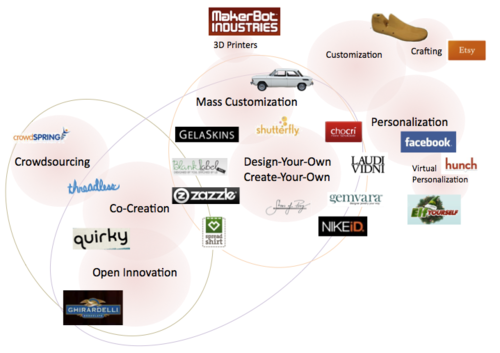
In his definition, and according to the graphic beneath, co-creation would encompass things like crowdsourcing, open innovation and some portions of 'create your own' as well as mass-customization. Quite a range ;-)
Somehow this makes good sense, but I think things are more entangled than what the picture shows. For instance, by crowsourcing new ideas or watch carefully what people design of their own, one naturally does some kind of open innovation? It's probably what the author meant with putting co-creation at the center of these activities. But there's probably a clearer way of presenting this... food for thought...
(+ note to myself: what the #§//° is virtual personalization???
Chart from: http://mass-customization.info/
Monday, May 9, 2011
Which industries will be threatened by -or benefit from- the disintermediation trend?
‘Disintermediation’ is definitely one of the most intriguing (mega)trend I follow.
The increasing level of specialization throughout human history has led to the creation of a large number of businesses –and indeed complete industries- that serve as an intermediate between entities in need and other entities providing specific skills, resources or other assets.
In a world dominated by the internet though, the value added of these intermediates might slowly evaporate. This potentially touches a wide range of industries:
Well, yes and no, according to this PEW survey (conducted only in the US and with a somewhat limited number of respondents). According to this survey, some people would rather go to family, friends or online communities for advice on medical matters.
The figures beneath don’t look spectacular, but this trend is likely to increase due to ageing population and the talent gap: there will be less doctors by patient in the future, so sooner or later people will have to find solutions for their immediate needs and concerns. As this survey indicates, they’d immediately go to family and close community for that…

Can you think of any other industries that might be threatened by (or benefit from) disintermediation?
The increasing level of specialization throughout human history has led to the creation of a large number of businesses –and indeed complete industries- that serve as an intermediate between entities in need and other entities providing specific skills, resources or other assets.
In a world dominated by the internet though, the value added of these intermediates might slowly evaporate. This potentially touches a wide range of industries:
- Advertisement companies are under threat as companies increasingly find their way to the creative minds directly through crowdsourcing;
- Some activities of the bank (lending money using saving accounts) might become obsolete as ‘peer-to-peer lending’ brings together lenders and loaners directly;
- The music industry used to decide which bands would get the chance to get in the studio and be distributed to the docile audience. Through the fan-funded model, this same audience now decides which band gets in the studio, and how they buy the music from these bands.
Well, yes and no, according to this PEW survey (conducted only in the US and with a somewhat limited number of respondents). According to this survey, some people would rather go to family, friends or online communities for advice on medical matters.
The figures beneath don’t look spectacular, but this trend is likely to increase due to ageing population and the talent gap: there will be less doctors by patient in the future, so sooner or later people will have to find solutions for their immediate needs and concerns. As this survey indicates, they’d immediately go to family and close community for that…

Can you think of any other industries that might be threatened by (or benefit from) disintermediation?
Friday, May 6, 2011
New world population forecast 2100: Africa to grow strongest
We all know the world population is growing, and we all suppose that the major contributor to this growth would be China and India, right?
Well, think again... according to latest projections of the United Nations the major contributors to this growth would be Africa! Of course, to be taken with some buckets of salt (much can happen between now and then), but still an interesting view:
(from The Economist)

Well, think again... according to latest projections of the United Nations the major contributors to this growth would be Africa! Of course, to be taken with some buckets of salt (much can happen between now and then), but still an interesting view:
(from The Economist)
"ON MAY 3rd, the United Nations produced its two-yearly update of the world’s population, which includes projections. The numbers show small tweaks since 2008. The global population is likely to reach 7 billion in October 2011, not spring 2012. And it may still be rising in 2100 past 10 billion, rather than being flat by then. But the most dramatic changes are national, not global. America's population, now 310m, is likely to rise to 400m in 2050 and 478m in 2100. China's is forecast to fall by 400m between now and 2100. Russia’s population is now 142m; Afghanistan’s slightly more than a fifth of that; Niger’s barely a tenth. But by 2100, Afghanistan is forecast to have the same population as Russia (111m) and Niger will be larger. Such forecasts need to be taken with a bucketload of salt: tiny shifts in today’s birth rate extrapolated over 90 years produce huge changes. But the general picture is probably right. Sub-Saharan Africa’s current population, at 856m, is little more than Europe’s and a fifth of Asia’s. By 2050 it could be almost three times Europe’s and by 2100 might even be three-quarters of the size of Asia. By any measure, Africa is by far the fastest-growing continent."

Thursday, May 5, 2011
Organic clothes and textile, a solution to water scarcity?
Water is inevitably getting scarce. According to the World Health Organization almost 1 in 5 people on this planet live in regions where water is physically scarce. The situation is likely to get worse:

There's many causes to that, but one of them is the amount of water needed to make clothes or other textiles. Just think that it requires 2700 liters of water to make a T-shirt and almost 11,000 liters to make a jeans (compared to the 2 liters of water a human needs per day to stay alive). Not all this water is spoiled in the process, of course, but much is.
Hence the need to rethink the way we produce textile. Fashion designer Suzanne Lee seems to have found a solution: organic textile. Looks nice and it creates loads of opportunities to mold the designs any way possible. There's a small drawback to it but, hey, nothing is perfect...
At any rate this is pretty close to the 'cradle to cradle' concept - much needed in the clothing business if you think that nylon for instance takes 250,000 years to degrade biologically...
Maybe organic clothes are the way forward...

There's many causes to that, but one of them is the amount of water needed to make clothes or other textiles. Just think that it requires 2700 liters of water to make a T-shirt and almost 11,000 liters to make a jeans (compared to the 2 liters of water a human needs per day to stay alive). Not all this water is spoiled in the process, of course, but much is.
Hence the need to rethink the way we produce textile. Fashion designer Suzanne Lee seems to have found a solution: organic textile. Looks nice and it creates loads of opportunities to mold the designs any way possible. There's a small drawback to it but, hey, nothing is perfect...
At any rate this is pretty close to the 'cradle to cradle' concept - much needed in the clothing business if you think that nylon for instance takes 250,000 years to degrade biologically...
Maybe organic clothes are the way forward...
Why customization is not necessarily good (the filter bubble)
Well here's an interesting thought...
Regardless of whether the starting point is right (Eli starts with comparing Google search results and concludes that these differ from person to person dependent on search history... some commentators on the video claim they did the test and it appears to be untrue -I still need to do the test myself), what's certain is that virtually all online information providers are aiming at providing you with exactly the type of info you might be interested in.
Is this bad? After all, we get so much rubbish everyday that we might do with some upfront cleaning, wouldn't we (imagine a world without spam!).
Well, Eli argues that if we did only receive tailored information we would miss a huge amount of things... new ideas mostly come through a confrontation with unexpected thoughts. New insights and revealing thoughts as well... in fact, in most of my Google searches I am hoping to find new ways of looking at things, unexpected angles to what I already know. How's a tailor-made algorithm going to deliver me that? Or will we be able to tailor-make these search algorithms ourselves in the future?
It's a confrontational thought... worth thinking about for a moment...
Regardless of whether the starting point is right (Eli starts with comparing Google search results and concludes that these differ from person to person dependent on search history... some commentators on the video claim they did the test and it appears to be untrue -I still need to do the test myself), what's certain is that virtually all online information providers are aiming at providing you with exactly the type of info you might be interested in.
Is this bad? After all, we get so much rubbish everyday that we might do with some upfront cleaning, wouldn't we (imagine a world without spam!).
Well, Eli argues that if we did only receive tailored information we would miss a huge amount of things... new ideas mostly come through a confrontation with unexpected thoughts. New insights and revealing thoughts as well... in fact, in most of my Google searches I am hoping to find new ways of looking at things, unexpected angles to what I already know. How's a tailor-made algorithm going to deliver me that? Or will we be able to tailor-make these search algorithms ourselves in the future?
It's a confrontational thought... worth thinking about for a moment...
Wednesday, May 4, 2011
Smart Grids as an answer to resource scarcity
No doubt the smart grid is a trend for the coming years. The smart grid refers to the intelligence with which electricity provisioning and usage will be managed in the future, by letting consumers decide which electricity source to use at any given time, for instance.
This will become inevitable as an answer to the increasing scarcity of natural resources, and chances are that something similar will occur for water. The video beneath provides a good intro to the subject (and for those already acquainted with the subject, this is 1 out of 5 pieces of the interview of Fortune magazine, click here to watch them all).
I'm myself relatively informed about the subject. Still, I was not fully aware about one aspect provided in the interview: ultimately parties other than the end customers might decide about the most efficient way for you to manage your electricity. The thought might be frightening, but if resource scarcity gets critical somewhere in the future, no doubt this option will be fully utilized...
This will become inevitable as an answer to the increasing scarcity of natural resources, and chances are that something similar will occur for water. The video beneath provides a good intro to the subject (and for those already acquainted with the subject, this is 1 out of 5 pieces of the interview of Fortune magazine, click here to watch them all).
I'm myself relatively informed about the subject. Still, I was not fully aware about one aspect provided in the interview: ultimately parties other than the end customers might decide about the most efficient way for you to manage your electricity. The thought might be frightening, but if resource scarcity gets critical somewhere in the future, no doubt this option will be fully utilized...
Tuesday, May 3, 2011
GenY at work: what exactly will change?
Generation Y and its impact on the working environment is one (rather obvious) megatrend I follow closely. There’s much confusion and loads of conflicting surveys about what exactly the impact will be of the GenY entering the professional environment now (Generation Y are youngsters born after 1980 and are defined by the fact that they are first generation with no clue about what a world without Internet or mobile phones look like).
Up to now my list of ‘reasonably certain’ consequences included things like:
- GenY will have different expectations about which technologies they use in a professional environment. They will prefer to use their personal smartphone and tablet computer, and expect their employer to open corporate applications through these.
- Ethics and social responsibility score rather high on their list of priorities. Apparently they’d prefer to work for companies with a clear ‘green’ profile. Their contribution and function within these roles will preferably contribute meaningfully to social challenges. It’s certainly a challenge for employers to present every job as being socially relevant, but it’s not unfeasible.
- GenY workers would prefer not to be bound by any physical location. We know for sure they are geographically more mobile than any previous generation, but apparently they’d want the same attitude to apply on their working environment. This doesn’t mean you’d have to fly them first class from home to work every day. It does mean that they expect to be able to ‘perform’ work from anywhere they happen to be at that moment (and at any time they feel to do some work). Exit 9to5 job, welcome virtual company…
Is there more? Well, yes. According to the consultant in the video beneath, the coaching and management style also needs to adapt to GenY workers. In all fairness, being from GenX, I think I adopt certain attitudes listed in the video as well. But then, I clearly remember what it was to live without mobile phones and internet…
Friday, April 29, 2011
Technology trends: how serious is Cloud computing?
Undoubtedly one of the major things happening now in information technology space is the move to ‘Cloud computing’. If you haven’t heard of the term yet, Cloud Computing refers to the fact that your computer programs and data don’t necessarily have to be on your computer or laptop, but could be run by a company on a server somewhere far away (or better: on multiple servers at once, in an unidentified location).
Sounds weird? Chances are that you are using one form or another of Cloud computing already. Gmail, Hotmail or even Facebook, in effect these are ‘Cloud’-based applications, since you don’t run any of the software to use these services on your computer. The only thing you need is an access to Internet.
We’ve seen various attempts in this direction in the past –anyone remembers the ‘Application Service Providers’? So why should it become real now? Well, the benefits and the technological possibilities have evolved, obviously.
Cloud is serious business, so serious that the World Economic Forum has spent a couple of workshops on the matter. The results are gathered in the document: Advancing Cloud Computing: What To Do Now?
This report offers some compelling read. It starts with some key figures with regard of Cloud computing:

The report then goes in length over the benefits and the issues of Cloud computing. Let’s not forget the participants of the workshops were mainly providers and government agencies –no end customers, which is a bit strange. Anyhow, on the benefits side the report stresses the fact that Cloud computing could be key to accelerate innovation. It’s interesting that they put this benefit much higher on the list than, take, the cost savings for corporate IT divisions:

The issues (and bottlenecks for adoption of the Cloud) offer no surprise, although I must confess I was not so much aware of the geopolitical implications of Cloud computing (most Cloud providers will likely be coming from the US).

Question is: will the benefits ever outweigh the issues?
Sounds weird? Chances are that you are using one form or another of Cloud computing already. Gmail, Hotmail or even Facebook, in effect these are ‘Cloud’-based applications, since you don’t run any of the software to use these services on your computer. The only thing you need is an access to Internet.
We’ve seen various attempts in this direction in the past –anyone remembers the ‘Application Service Providers’? So why should it become real now? Well, the benefits and the technological possibilities have evolved, obviously.
Cloud is serious business, so serious that the World Economic Forum has spent a couple of workshops on the matter. The results are gathered in the document: Advancing Cloud Computing: What To Do Now?
This report offers some compelling read. It starts with some key figures with regard of Cloud computing:

The report then goes in length over the benefits and the issues of Cloud computing. Let’s not forget the participants of the workshops were mainly providers and government agencies –no end customers, which is a bit strange. Anyhow, on the benefits side the report stresses the fact that Cloud computing could be key to accelerate innovation. It’s interesting that they put this benefit much higher on the list than, take, the cost savings for corporate IT divisions:

The issues (and bottlenecks for adoption of the Cloud) offer no surprise, although I must confess I was not so much aware of the geopolitical implications of Cloud computing (most Cloud providers will likely be coming from the US).

Question is: will the benefits ever outweigh the issues?
Tuesday, April 26, 2011
Will Western students move to universities in emerging countries ?
I’m trying to build an argument for the thought that the trend toward geographic mobility will increase with the upcoming Generation Y.
The most obvious argument is that young people will likely move to where the action is, read: where the economic growth is… In the future they even might have more favorable working conditions there –a better salary or more chances to get promoted. Some that have moved probably obtained higher salaries already.
But in the future young Western people might move to ‘developing’ countries for better education offerings as well. This is debatable, so I went looking for some hard facts. There are a couple of lists of top universities globally. Let’s take 3 of them and see how many are located in emerging markets:

(the numbers refer to the ranks on the lists, Hong Kong not included)
So in average about 5% of the top 200 universities are from ‘emerging’ countries (7% if you include Hong Kong). Not too bad, but it gets more interesting if you look at the ‘popularity’ of the universities. A list built by 4icu uses some algorithm to gauge the popularity of the internet websites of the universities globally. This list suddenly looks very different
(in order of first appearance in the list, excluding Hong Kong):

Surely this list is biased, since it’s partially based on number of visits to the websites of these universities.
Still the question is intriguing: could the list of best universities look like this ten year from now? And will these increasingly attract Western students, worsening the talent shortage in the West?
The most obvious argument is that young people will likely move to where the action is, read: where the economic growth is… In the future they even might have more favorable working conditions there –a better salary or more chances to get promoted. Some that have moved probably obtained higher salaries already.
But in the future young Western people might move to ‘developing’ countries for better education offerings as well. This is debatable, so I went looking for some hard facts. There are a couple of lists of top universities globally. Let’s take 3 of them and see how many are located in emerging markets:

(the numbers refer to the ranks on the lists, Hong Kong not included)
So in average about 5% of the top 200 universities are from ‘emerging’ countries (7% if you include Hong Kong). Not too bad, but it gets more interesting if you look at the ‘popularity’ of the universities. A list built by 4icu uses some algorithm to gauge the popularity of the internet websites of the universities globally. This list suddenly looks very different
(in order of first appearance in the list, excluding Hong Kong):

Surely this list is biased, since it’s partially based on number of visits to the websites of these universities.
Still the question is intriguing: could the list of best universities look like this ten year from now? And will these increasingly attract Western students, worsening the talent shortage in the West?
Friday, April 22, 2011
Generation Y @ work... less loyal, but that's the employers' fault?
I can't understand why McKinsey made the video interview beneath so short, but it's still a worthwhile introduction to a hot subject: how does Generation Y look at their professional environment? Are they less 'loyal' to their employers? What can employer do to retain young talent when it's so easy for them to look and find the next big opportunity?
If you have some datapoints on the subject please leave a note beneath...
(From McKinsey Quarterly:) Clay Shirky, author and professor of new media at New York University, has written at length about Twitter’s and Facebook’s influence on politics and economics, even before the social-media tools played a key role in the popular movements sweeping across the Middle East.
These technologies also shape behavior at the office, especially for younger employees who log into Facebook at work, e-mail from their BlackBerry on weekends, and consider their career paths pliable and open-ended.
In this interview, conducted at this year’s World Economic Forum, in Davos, Switzerland, Shirky sits down with McKinsey’s director of publishing, Rik Kirkland, to explain the opportunities and constraints that net generation employees balance at work, as well as how managers can do a better job of understanding and retaining them.
If you have some datapoints on the subject please leave a note beneath...
(From McKinsey Quarterly:) Clay Shirky, author and professor of new media at New York University, has written at length about Twitter’s and Facebook’s influence on politics and economics, even before the social-media tools played a key role in the popular movements sweeping across the Middle East.
These technologies also shape behavior at the office, especially for younger employees who log into Facebook at work, e-mail from their BlackBerry on weekends, and consider their career paths pliable and open-ended.
In this interview, conducted at this year’s World Economic Forum, in Davos, Switzerland, Shirky sits down with McKinsey’s director of publishing, Rik Kirkland, to explain the opportunities and constraints that net generation employees balance at work, as well as how managers can do a better job of understanding and retaining them.
Wednesday, April 20, 2011
(book review) "2030, Technology that will change the world" (Van Santen, Khoe, Vermeer)
Despite of the catchy title this is a relatively down-to-earth account on how technology might resolve some of the challenges the world is facing in the next decade. The book is –I guess- intentionally kept simple and high level. For specialists in any of the matters that are treated in the book it will therefore look almost simplistic. It doesn’t help that many of the ideas expressed are based on interviews with a single expert in each of the field. On the other hand, this is probably contributing to the clarity of the view expressed.
Check out my previous book reviews:
But the beauty of the book lies in the breadth of topics covered. The authors investigate how technological evolutions apply on ‘usual suspects’-topics such as climate change, energy shortage and Health Care, to name just a few, but also on less obvious subjects such as pandemic risks, ageing population and peace.
An ambitious program… Perhaps too ambitious for a book of 260 pages. Unsurprisingly the authors stay somewhat vague on some of the subjects, and sometimes the link with technology is hard to find.
Nevertheless, it offers some surprising perspectives which at least should be common knowledge for everyone dealing with the future, with technology, or with innovation.
Nevertheless, it offers some surprising perspectives which at least should be common knowledge for everyone dealing with the future, with technology, or with innovation.
Some examples:
- Most of the water usage in the world is used in farming, especially in land irrigation. The scarcity of usable water is currently most acute in Africa, where water supply for basic human needs conflict with its use for irrigation purposes. However, there are times at which water for irrigation is most efficient, and these times depend on weather conditions. But these are hardly known in most parts of Africa, there are simply too few weather stations to report on local weather conditions. Advising local farmers on the best time to use water for irrigation, is a major challenge because of this. The solution? Provide local farmer communication tools to report on weather conditions, so someone can advise them ‘on the spot’ on the most efficient periods for irrigation. Simple, clear, doable.
- Another puzzling reasoning: air pollution is de facto slowing down global warming, because the sulphur it contains. Obviously, the answer to global warming is not to pollute more, but are there ways to develop some ‘clean pollution’ that might stop global warming? It doesn’t exist yet, but is it possible?
- The answer to some of the risks modern life brings along (pandemics for instance, but also air traffic) is, according to the authors, the decentralization of decision taking. Much like the Internet is self-healing since it doesn’t have a central decision power (but rather, connected nodes that can change according to the state of the network as a whole), other systems might benefit from a decentralized decision model. It is a thought that is worth much more thought than what the book provides. Perhaps a separate book altogether.
The book might have done with double the amount of pages, though it would've made it les enjoyable... The Return on Investment for the time spent on 260 pages is pretty high (hey, did I just find a new metric to judge the value of a book? ‘Return per Page Read’, or RPPR? Quickly trademark that one ;-)
Click to buy on Amazon.com:
Click to buy on Amazon.com:
Check out my previous book reviews:
- "What Technology wants" David Kelly
- "Crowdsourcing" Jeff Howe
- "The next big thing" William Higham
- "Future Files" Richard Watson
- "Future savvy" Adam Gordon
- "Futurewise" Patrick Dixon
- "Ecological intelligence" Daniel Goleman
Tuesday, April 19, 2011
Technology pioneers 2011 (WEF report)
The Technology Pioneers 2011 - Empowering People and Transforming Society report from the World Economic Forum offers some interesting read, since the technologies that innovators are working on today will shape our world tomorrow... Unsurprisingly, most companies in this year's list of 31 technology pioneers are about improving sustainability challenges, with a couple of noteworthy exceptions.
The most striking conclusion is that 18 companies out of the 31 listed have their origin in the United States. Europe, with 5 companies (2 from the UK, 2 from The Netherlands, 1 from Switzerland) looks a bit bleak in comparison (the WEF is based in Switzerland, so you can't blame this on US-centricity of the organization). Interesting as well: the first African company to appear on the list is from Nigeria.
The 2 'tech pioneers' that got most of my attention were:
The most striking conclusion is that 18 companies out of the 31 listed have their origin in the United States. Europe, with 5 companies (2 from the UK, 2 from The Netherlands, 1 from Switzerland) looks a bit bleak in comparison (the WEF is based in Switzerland, so you can't blame this on US-centricity of the organization). Interesting as well: the first African company to appear on the list is from Nigeria.
The 2 'tech pioneers' that got most of my attention were:
- Novacem (UK), a company that not only found a way of reducing the CO2 emission of making cement, but they even make this cement absorbing CO2!
- ReputationDefender (US), a software company that helps to manage (and correct) our online profile, no doubt this type of tools will become increasingly important (and maybe this is a prelude for a trend towards asocial media?)
Subscribe to:
Posts (Atom)