Monday, June 20, 2011

5 megatrends according to CSIRO

I think I mentioned this report before, though it's the first time I've been through it with more attention. The document 'Our future world -an analysis of global trends, shocks and scenarios' from the CSIRO (Commonwealth Scientific and Industrial research Organization) offers some interesting read, mainly for its supporting trends.

Just a pity they only selected 5 megatrends (out of 100, according to them), the same exercise would have been useful covering less obvious, or even uncertain trends. Well, that's basically what I try to achieve with this blog ;-)

Also to keep in mind, when the CSIRO presented this at a conference last year, a consultant from Bridge8 argued that each of these 5 trends might in itself create 'anti-trend'. Grossly, the argument-counter argument went as follow:

Click here for the complete CSIRO report, or watch the introductary video beneath.

Wednesday, June 15, 2011

Another good example of the social entrepreneurship trend

One for the record, since I was investigating some evidence of the trend towards social entrepreneurship. The one beneath sounds like a good best practice to keep in mind:

(text copied from Youtube:) "The Social Entrepreneur is a documentary featuring Rob Smith, the CEO of Earthwise Ventures. Rob and his team at Earthwise are embarking on a revolutionary project that could transform the economies of the African countries surrounding Lake Victoria and serve as a template for future entrepreneurial investment around the world. The film is still in production and the release date has yet to be determined."

Tuesday, June 14, 2011

Will consumerization of IT become mainstream?

Much has been said about the 'consumerization of IT'. Many say it is an unavoidable fact, but the people I speak to -both from the IT world as well as corporate leaders- seem to say this is not likely to ever happen. For those of you unaware of the 'consumerization of IT' trend, it's basically about being allowed to use personal devices for professional means.

The video beneath provides a good -and fun- introduction:


I guess it's part of corporate culture whether or not it will happen. But the real question is whether (young) people will really want to use personal devices at work. From the multiple surveys I've been through, it would appear that this would be the case for hardware (smartphone, iPad, ...), but not so much with software, especially social networks (except for LinkedIn, obviously).Many perceive Facebook as being something personal that shouldn't interfere with work.

One strong indication that this trend is happening whether or not the corporate IT department is in favor of it -or supporting it- is shown  in a survey from IDC, commissioned by Unisys (Unisys consumerization of IT benchmark study).

It's an interesting study altogether, but what stroke me most is this chart, that shows the perception gap between what IT perceives as being used in the corporate environment, and what the workforce really uses.There are some major disconnects in the utilization of computer and phones, but more strikingly this chart shows that in almost all these technologies the use of personal devises outpace what the IT department thinks is happening.


One could easily conclude that this trend is unstoppable?

Monday, June 13, 2011

The impact of megatrends on the Western Retail sector

 I'm currently digging deeper into the consequences of megatrends on different sectors. As I stated earlier, a trend might mean something completely different dependent on the industry you serve. Ultimately it's even going to be dependent on your company's specific context, your culture, your mission, your vision. But in the meantime there are common conclusions to be drawn by industry.

Here's an example for the (Western) Retail sector (I do think that the Retail sector in the emerging countries would give a different view; I would've put more emphasis on the emergence of megacities, for instance):

Friday, June 10, 2011

Internet traffic set to quadruple by 2015

Interesting infographic from Mashable hereunder, based on a forecast from Cisco. The main message is that internet traffic is posed to grow exponentially, to reach 1 zettabyte per year by 2015. If you don't know what a zettabyte is, it is explained in the chart hereunder (a one followed by 21 zeros).

What stroke me most, however, is the projection saying how many devices we'll have in average per person: 5.8 in the US, 4.4 in Europe. Surely by then we will get tired of carrying multiple devices around? Or a brilliant designer at Apple would have created one single device that serves as a laptop, a smartphone, an e-reader and an iPod all at once?

Perhaps of more serious concern is the eWaste generated by all these devices... perhaps the electronic and technology sector can get serious about integrating bamboo components in their devices, even if it's only for their packaging (both ecological and economical advantages here):


...and here's the infogrpahic by Mashable:

Thursday, June 9, 2011

New trend in outsourcing: microtasking

Is it crowdsourcing? In a way, yes… except that in this model the outsourcing of tasks is not done to an anonymous crowd per se.

Is it social entrepreneurship? In the eyes of Samasource, yes, definitely. The aim is to help out poorer classes get some kind of paid job.

Fact is, with the emergence of microtasking, outsourcing takes quite a different proportion. This definitely makes sense for companies: why bother paying relatively high waged locals to do relatively low-skilled tasks, while one could outsource this to a multitude of eager people in emerging countries? Surely it’s more efficient to do so, and on top companies can profile themselves as doing something good for society.

I have quite some difficulties imagining which specific tasks this would be, but according to the CEO of Samasource beneath, there should be plenty. No doubt this might become big:

Wednesday, June 8, 2011

Europe's future: from Lisbon to Vladivostok?

How will regional free-trade regions evolve in the future?

It’s probably fair to say that global organizations such as the World Trade Organization (WTO) or the International Monetary Fund (IMF) have failed to turn the world into a unified, coherent block of like-minded parties. There are various reasons for that, the major one being that these organizations can hardly be suspected of ensuring the best interest of all of their members (read Joseph Stiglitz or Naomi Klein to know more about this).

Regardless of the question whether such a unified world would be a good thing or not, the conclusion is that -until it does- partnerships between countries will become increasingly important, and hence will be subject to some transformation in the future.

The current state of these regional alliances looks like this:


Except for the scattered Africa, most of the trading blocs follow the logic of the geographic continents. Judging from this map, two moves would likely occur somewhere in the next ten years.

For one, China is currently part of no group at all. It doesn’t have to, for now. It has easy access to most of the worldwide markets, and its internal market is big and booming enough to keep it safe of any need for further integration with any other region. But, for the sake of argument, say that the US and European markets would become tougher with Chinese exports. Not such an unrealistic scenario. Where would China turn to? It ‘owns’ Africa already, the US and Europe would be closed, so they’d have to turn to India, Russia or South-East Asia. In either scenario, it might be a blow for Western export markets.

A second oddity is the European Union. It’s the biggest single consumption market in the world for now. But it’s hardly a noteworthy political power at a global scale –even if the European countries would have a single foreign policy, which isn’t the case now despite of its lip service, it would still have to cope with its limited geographic reach. An extension to the East (difficult and strange, but not unfeasible) would make sense.

The video beneath gives some proof of point. Made by the World Economic Forum, it was meant as an introduction to a conference between Europe and Central Asia. But, between the lines, on sees an effort to show that both regions have many stakes in common:

Tuesday, June 7, 2011

Chinese businesses' strategy when acquiring Western companies

In one chapter of the book about megatrends in corporate strategy I’m soon to publish I dig deeper into the consequences of the increasing number of takeovers of Western firms by Chinese investors.

Strikingly, evidence so far (Volvo, Teck Resource, Addax amongst others) suggests that the Chinese owners pretty much leave the situation unchanged. In the case of Volvo, they left the management team untouched (except for the CEO) and only want to have a say in the global strategy and expansion of Volvo’s brand.

This is refreshing, especially when compared to how the Japanese used to treat acquired companies back in the ‘80s. Somehow this is also embedded in the Chinese culture, in which 2 sometimes opposite systems can perfectly well exist in parallel (for more on the subject I’d suggest to take 15 minutes to listen to professor Martin Jacques at a TED conference).

This looks like a clear strategy of Chinese companies that invest in Western companies. But it is also exemplified by the localization policy of Chinese multinationals. Telecom equipment company Huawei is a case in point. They just appointed a purely local Board of Directors in their Australian operations.
It’s quite interesting to hear one of these Directors discuss the lack of transparency of Chinese companies as well as the ties between Chinese business leaders and politicians. According to him, Huawei is opening their books for audits (though it doesn’t have to), and Chinese business leaders have to stay clear of political influence if they want to be successful globally:

(a sign that things don't change that quickly after all? the Youtube video embed function was disabled by request... clicking the pic beneath will bring you directly to the Youtube location)


I wonder of this is a strategy that will be sustained, but there’s no reason why it shouldn’t. I’ll follow this one closely nevertheless.

The power shift to the east... is Europe really set to decline?

Much has been said about the decline of the West -in terms of weight in the global economy this is. Undoubtedly the weight of the West will decline, provided that its economic growth is below that of the emerging markets. I think Looking at the latest projection of Price Waterhouse Coopers, the top 10 economies worldwide  would count only 2 European countries by 2050, there are 4 today.


Nevertheless, all is not bad. Looking at the Ernst&Young report on global Foreign Direct Investments (FDI), Europe still shows as the second most attractive destination for FDI, and in terms of size the European countries combined are still will above the US when in comes to attracting FDI's.No guarantee for the future, obviously, but still pretty far from a doom scenario, especially if you consider the growing importance if Chinese and Indian investments in Europe...

(From the report:)
Global conclusions:
  • Though China is rated the world’s most attractive investment region with a score of 38%, Europe ranks second in 2011 — awarded a score of 35% by investors.
  • In 2010, emerging markets collectively harvested more than half of global inward FDI for the first time, though their performances varied: while the value of FDI into Brazil grew 16.3% on the back of commodities and consumption, the value India’s inward investment fell 31.5%, slowed by strong competition for investment projects. China’s FDI inflows grew steadily, underpinned by stable returns on investment.
  • When considering where to invest in 2010, companies view transport and logistics infrastructure (63%), telecommunications infrastructure (62%) and stability and transparency of the political, legal and regulatory environment (62%) as the most critical factors.

Major charts:
  • The attractiveness of Europe as FDI destination is declining but still ranks second next to China:

  • The majority of FDI inflow still originates from the US, but outside of Europe China and India start taking major positions:

  • The 4 major European FDI inflow countries (UK, Germany, France and Belgium) together still account for more than US FDI inflow:

(Click here to access the full E&Y report)

Monday, June 6, 2011

Open your strategic planning event with a keynote on megatrends!

Looking for an impactful opener for your strategic planning meeting?
…or an eye-opener for a conference about the future of your industry?

How to better start your strategic meeting but with a keynote presentation that will open the minds of your audience and make them aware of all the possibilities of the near future? You would be certain to obtain better insights and ideas for the future of your company and industry!

Start your meeting with a keynote speech about megatrends !

As a passionate researcher of megatrends and a knowledgeable business strategist, Frederic De Meyer combines the expertise needed to provide valuable input at the start of your strategic planning meeting, or your industry gathering.

The keynote addresses topics like:
  • Concrete examples of how companies benefit or suffer from megatrends;
  • Which megatrends will affect your industry and how companies can optimally prepare for them;
  • How to determine which megatrends need immediate actions from your company;
  • How to build a megatrends exercise in-house in order to adapt your strategy to the challenges and opportunities ahead.
You will find a generic slidepack on the top right of this page. This presentation can obviously be adapted to your specific situation or environment, zooming in on the megatrends that are directly relevant to you. These megatrends will be treated in light and impactful ‘fact sheets’ that will be sent to you separately as well.
Start building on the successful future of your company! Start your meeting with a keynote speech on megatrends!

The amount of speeches or workshops I can deliver yearly is limited!

Giving speeches and lectures is not my only job, however. Hence, the amount of interventions I can do is limited. This amount is dependent on the locations of the meeting, but currently I only have room for 4 more international speeches in 2011. Book yours now to ensure your future success!

Click here to discuss availability and prices (please indicate your location and industry as well). I will get back to you within 2 business days.

See you soon !

Frederic De Meyer
(Click here to view my LinkedIn profile. Feel free to send me an invite if you want to keep the idea of a megatrends keynote in mind for later)

(PS: I don't deliver any speeches or workshops for direct competitors of my current employer!)

3D printing becomes mainstream, but is it useful?

It's still pretty inconceivable to me, '3D printing'. You want to print an article to read, or some pictures you took on holiday, but that's 2D. What's the need for 3D? Sounds like another gadget...

Well, not so fast... it would be handy to print spare parts for, say, a broken table leg. Just take a 3D picture, and the 3D printer would build a spare one with exact the same measures. Better than messing around for half a day trying to manufacture something similar (especially if you're born with two left hands, like me).

3D printing doesn't sound so absurd any longer and, according to the report beneath, will become a device for the masses pretty quickly:


Friday, May 27, 2011

How companies should adapt for the consumers of the (near) future

Pitty I missed the Future Summit in Brussels two weeks ago... I would've loved to hear Mike Walsh speaking. Luckily, it becomes a habit for conference organizations to post highlights and interviews from the event on Youtube. Here's the interview with Mike, where he gives some advise for companies on how they should transform themselves to deal with the future.

(From FlandersDC) "Mike Walsh explains how to be a futurist: not by focusing on technology but on anthropology. Look what consumers in emerging markets are doing. Understand the power of networks: not how consumers are connected to you but to each other. Walsh ends with his advice for media companies: collect data on what/who people are. Stop playing the paywall game unless you want to lose to the revolutionaries."


Wednesday, May 25, 2011

Why humans are addicted to predictions that (almost) always prove to be wrong

Haven't read Dan's book yet ('Future Babble: Why Expert Predictions Are Next to Worthless, and You Can Do Better', it's on my list), but in the meantime it's interesting to hear the author talk about it. The book is about why humans are so desperately in need of predictions, even if most of them never come true. In fact, it's even relatively insane to even listen to 'experts' talking about the future...

But wait a minute... Is this not what I try to do when looking at megatrends? Well, yes and no... to say it in the words of management guru Peter Drucker: “The trends that I have described are not forecasts [...]; they are, if you will, conclusions. Everything discussed here has already happened; it is only the full impacts that are still to come”. In that way I stay far clear of any 'prediction', although, since I'm a human after all, I can't completely omit them...


Monday, May 23, 2011

Is our future made of 'peer-to-peer' services?

In a previous note I was wondering which other activities might be subject to 'desintermediation', through the emergence of 'peer-to-peer' platforms. I mentioned banking, music production, even Health Care as being prone to this trend, but I wasn't looking far enough... this short vision published by fastcompany.com reveals plenty more possibilities. I doubt whether this vision would make my life easier, but it would certainly make it more sustainable and less expensive...

From FastCompany


A version of this article appears in the May 2011 issue of Fast Company.

Thursday, May 19, 2011

The real benefits of the Internet of Things seen through the eyes of 3 major players

The Internet of Things (IoT) is a trend that promises to shake up our existence quite dramatically. At least, that's what many tech providers want us to believe.

One might get skeptical about the real need for our fridge to tell us whether the milk inside it is running empty. You might as well open the door and check. Our what about our jogging shoes that keep track of our route and post it real time on our Facebook-page? Surely this would make a fascinating read for all my friends?


All jokes aside, the Internet of Things does much more than that. It could make our energy usage more efficient, monitor the physical environment much closer in order to make smarter use of it, and it could make living in (ever growing) cities more sustainable.


To obtain a better understanding of the potential of the IoT, it's worthwhile to examine the positions of its 3 major players: Cisco, IBM and HP.

Let's start with Cisco. In this clip (if you manage to watch it fully without being distracted by the nerving background music) Cisco focuses on the monitoring function of the IoT (for water usage and health, for instance). Interestingly, it starts with saying the IoT could help to bridge the gap between rich and poor, but does not explain why (well, you'd have to deduce it from what follows).


To IBM the IoT is more something inherent to our lives, and benefiting from it is more a question of getting the wisdom out of all the data collected. In this clip IBM stresses the benefits for personal use of the IoT, although this is part of their generic 'Smarter Planet' project so ultimately would benefit society as a whole. No thorough explanation here neither.


HP communicates on the IoT through a series of interviews with people in HP Labs. Unsurprisingly it stresses the fact that HP has the end-to-end solution for the IoT. To be fair, this is only one of the many interviews one can find on Youtube, and the overarching vision of HP is put in its CeNSE program (Central Nervous System for the Earth) which has already a flagship project with Shell.


So, the IoT has some promises and, as stated in the Cisco video, it has some bottlenecks before it can realize its full potential.

However, there's one aspect that none of these video's reflect. No doubt the trillions of datapoints gathered are of enestimable worth (if analyzed efficiently). But where will it be stored? Who will own this data? Will we have to pay  for using it? If so, we might end with 3 different wireless tags on each product, each of them for different data collectors... this just doesn't make sense...If not, this would mean that all providers should open their database to anyone else. The latter make sense. As stated in the clips above, the real value is not the data itself, but the wisdom we can get from it!

Wednesday, May 18, 2011

Making globalization work, some practical ideas

Let’s face it; the current state of globalization doesn’t live up to its promise. While in theory more international trade would mean more wealth to more people, in practice it only benefits a few countries, en within these countries a handful of companies and persons.

The supposed ‘trickle down’ effect (where the wealth of the riches automatically cascade downwards to the poor) is not occurring, and countries that have focused on their ‘competitive advantage’, as economic doctrine pushes them to do, at the end have found themselves dependent on the goodwill of more powerful (and often more protective) counterparts.

Is globalization therefore evil? Not so, according to Nobel prize winner Joseph Stiglitz, is has only not been applied adequately.In his ‘Making Globalization Work’, Stiglitz provides a thorough account on where the mechanisms of the current globalization fail, and –more importantly- provides some concrete ideas on how these mechanisms could be changed to work for the greater good. Some examples:

 Making trade fair

Trade obviously is at the heart of globalization, and pumping this heart are the agreements and rules made between countries in the ‘World Trade Organization (WTO)’. These rules, however, are largely influenced by the bigger countries to protect their core interests. Trade has never been free, nor fair, argues Stiglitz. From the European cows who are subsidized at twice the level of human subsistence (1$ a day, according to UN definition), to the US using creative definitions of ‘dumping’ in order to levy taxes on some critical goods  (critical in the sense that they have a large industry producing these same goods), Stiglitz goes at length about the unbalanced way international trade is being organized today.

The system is particularly unfair to smaller countries, who’s political and economical weight are mostly insufficient to defend their interest, or even to defend themselves when their interests are threatened. One of the ideas Stiglitz proposes, is to enable these smaller countries to sell these litigations to more powerful countries. If the US harms the fair trade interests of, say, Burkina Fasso, this country could sell this litigation to Europe who would go to trial and get the compensations if the trial is won. Sounds like a plan ;-) But it is emblematic for the refreshing, ‘out of the box’ ideas that Stiglitz proposes throughout the book.

Patents and people

The subject of patents, and how they are often used to create monopolies or trade advantages, is a relatively harsh one. The best example of how unfair this procedure has become, is given by the so-called ‘bio piracy’. Large corporation have attempted (and succeeded) to get patents on cures with natural substances that have been used by local populations for ages. This lead to the absurd situation where local villagers in a remote country theoretically had to pay right to foreign companies in order to keep on producing medicines in the same way they have done for centuries. ‘They could’ve patented these medicines themselves’, argues the pharmaceutical and the cosmetic industry…

Taking this as example, Stiglitz defends the protection of ‘traditional knowledge’ on which nobody could be granted any patent. Makes sense.

The burden of debt

Another hot issue –especially today when many Western countries have to cope with debt problems- is the debt of countries. According to Stiglitz, for developing countries this debt was often pushed for by the International Monetary Fund (IMF), even if they were not per se necessary. The IMF had its own interest in pushing –or forcing- countries to adopt a neoliberal route (formalized by the Washington Consensus). How these dogma’s have often put countries in even more trouble, instead of helping them, is strikingly explained by Naomie Klein in her “The Shock Doctrine: The Rise of Disaster Capitalism”.

One specific problem pointed out by Stiglitz, and one that I didn’t realize so far, is what to do with ‘odious debts’, like debts incurred by dictators to buy weapons in order to repress internal opposition. When the dictator ultimately comes to fall, should the population of a country still be accountable for these debts? The answer of Stiglitz sounds reasonable to me: NO! Country debt is as much the responsibility of the lender as of the loaner. If a Western bank want to lend money to a dictator, for whatever purpose, it should be made aware that the debt will not be paid back in the event the dictator would fall. Obviously this is not an easy rule to work with (what exactly is a ‘dictator’? This notion would/should be based on consensus, in the UN for instance, where dictators also have a seat…). Nevertheless, the concept is crucial since it will make Western loaners think twice about who they lend to.

In short, this is an essential book for everyone interested in world affairs, both for the way it points to critical failures of the current system in a crystal-clear way, as well as  for the multiple practical and realistic ideas it proposes to resolve the pain-points and build a fair(er) globalized world.

Click here to buy on Amazon.com:


Check out my previous book reviews:

How crowdsourcing can help companies be more efficient

...in case you are shy of a definition of crowdsourcing and how it could help companies to be more efficient, this short video is probably a good start. The video was taken from the excellent site  www.crowdsourcing.org . Another good way to keep pace of the trend is to follow @crowdfundnews on Twitter...  

More to come...

Monday, May 16, 2011

Social entrepreneurship, a hype or a sustainable business model?

I’ve come across a lot about ‘social entrepreneurship’ lately –small-sized companies that aim at doing well for their direct environment, for a profit. This is different from the trend towards ‘corporate citizenship’ where existing companies take some active participation in ‘doing good’ for their environment. Social entrepreneurship is about creating complete business model around the idea of ‘doing good’.

The idea is appealing and –from what I know so far- gained great traction in the US.

Looking to assess how important it is in the rest of the world, I came across the Schwab Foundation for Social Entrepreneurship which organizes a yearly prize of best social entrepreneur by continent. The 2010 list of winners look quite interesting in all of the continents, except the winning initiatives from Europe who –with all respect- look a bit meager.

Nevertheless, social entrepreneurship is clearly on the rise, and educational programs across the world are driving youngsters to adopt –or at least be aware of- its potential. For instance, in the UK there is a school for social entrepreneurship, and in the US –as the video beneath testifies- there are experienced entrepreneurs going around high schools promoting the idea.

No doubt this trend that is more than a hype. looking at the aspirations and attitudes of Generation Y workers, this could become a major (business) trend in the near future. No doubt something to follow up on.


The future is made out of silk!

okay, I reported on the vision 'the future is made of glass' before (a vision by Corning), so this post might look like I changed my mind...

The glass vision was more about gadgets though, whereas the capabilities of silk are somewhat of a different -more fundamental- nature, according to Fiorenzo Omenetto. The potential applications look (almost) limitless... and sustainable!

From TED: "Fiorenzo Omenetto shares 20+ astonishing new uses for silk, one of nature's most elegant materials -- in transmitting light, improving sustainability, adding strength and making medical leaps and bounds. On stage, he shows a few intriguing items made of the versatile stuff."


Wednesday, May 11, 2011

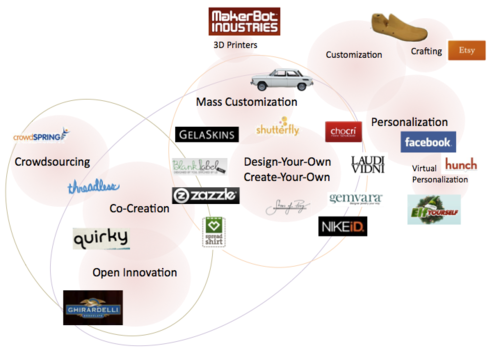
The link between crowdsourcing, open innovation and mass customization? Co-creation

I've been puzzled by the chart beneath for some days now. It comes from the website mass-customization.info, where the author uses it in order to provide a definition of co-creation.

In his definition, and according to the graphic beneath, co-creation would encompass things like crowdsourcing, open innovation and some portions of 'create your own' as well as mass-customization. Quite a range ;-)

Somehow this makes good sense, but I think things are more entangled than what the picture shows. For instance, by crowsourcing new ideas or watch carefully what people design of their own, one naturally does some kind of open innovation? It's probably what the author meant with putting co-creation at the center of these activities. But there's probably a clearer way of presenting this... food for thought...

(+ note to myself: what the #§//° is virtual personalization???

Chart from: http://mass-customization.info/